
Educational 5 min read
The most important BJJ escapes for white belts
Beyond the Mat
Watch a white belt escape mount. They buck, they push, they turn onto one side, they grab at a leg, and eight seconds later they stop, out of breath, in exactly the same place with less left in the tank.
Watch a purple belt do it and almost nothing happens for a while. Then they are out.
The difference is not strength and it is not flexibility. One of them is doing three things in order. The other is doing three things at once.
An escape has an order
Every escape from every bad position is the same three steps, and they only work in this sequence.
Make space. Bridge, shrimp, turn, whatever the position allows. You need a gap. It does not have to be a large one, but without it nothing else here is available to you.
Get a frame into the gap. A forearm, a shin, a knee. Something structural that props the space open so it does not shut the moment you stop pushing. The frame is what makes the space stay.
Recover a position. Bring a knee in, turn onto your side, get your hips back underneath you. This is the part that changes where you are.
Beginners attempt all three simultaneously, which means they achieve none of them. You cannot frame into a gap that does not exist yet, and you cannot recover a position through a frame you never built. If you have ever gassed after two escape attempts, that is what happened.
What follows is that sequence applied to the four positions you will spend most of your first year in.
Under mount
The mistake is pushing on their chest.
It is the most natural thing in the world and it is the reason your arms are finished in round one. Straight arms are a gift to the person on top, and pushing someone upright does not move them anywhere useful. It moves you into the mat.
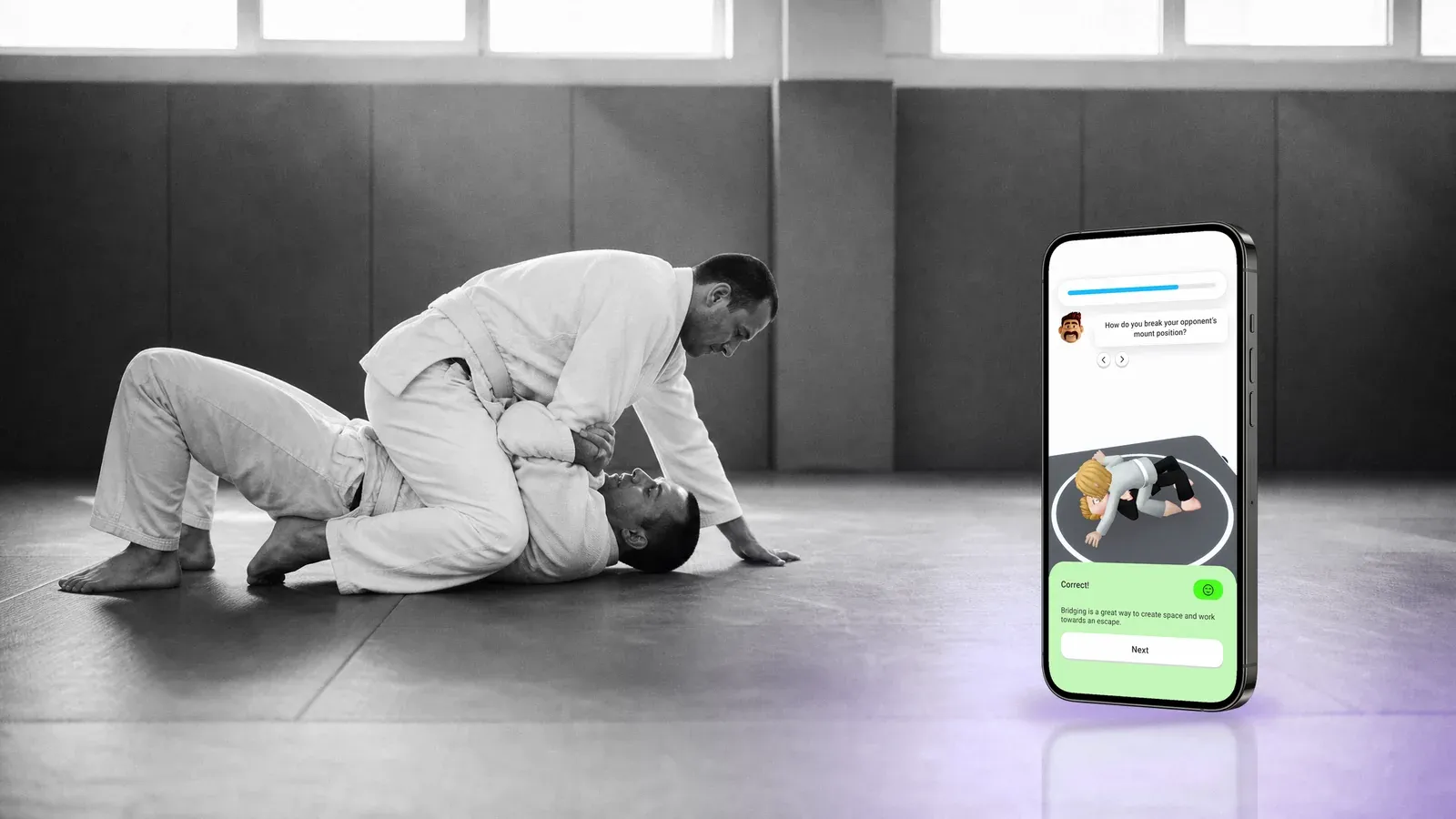
Do this instead. Trap the arm and the leg on one side so they cannot post out, then bridge over that shoulder rather than straight up. Your hips are the strongest thing you own and their base is what you are trying to break. When they tip, the space appears, and your elbow goes into it before anything else does.
If you take one habit from this article, take that one. Hips before hands, every time.
There is a second way out of mount, the elbow escape, where you work a knee back in rather than tipping anybody over. Long term it is the more reliable of the two. But it needs space that you usually have to bridge for first, which is why the bridge comes earlier here and should come earlier in your training.
Under side control
This is the position you will be in most and understand least, so it has a post of its own with the frames explained properly. Read that one before your next class.
The part that transfers is this. You are not trying to get them off you. You are trying to get your knee back in. Those are two different jobs and only one of them is realistic against somebody heavier. Elbows stay tight to your ribs, you face them rather than lying flat, and every small movement is aimed at making room for a knee rather than at moving another human being.
When they have your back
Hands first, hips second. Protect your neck with one hand and fight the grip with the other, keep your chin down, and get your back flat towards the mat rather than lying on your side, because a side-on back is a finished back. Only when the choking arm is under control do you start sliding your hips out.
Aisha has written about why the back ends rolls and what the seatbelt grip is actually doing. Understanding what is holding you there makes the escape make sense, so start with that.
Under north south
The mistake is reaching up for their hips and pushing, trying to shift them off you. Their weight is on your chest and their hips are nowhere near the pressure, so nothing moves except your own shoulders, which come off the mat.
Use the same hands differently. Put both forearms into their hips as a frame, not to move them but to stop them settling chest to chest, then turn to face one side. North south is only genuinely bad while you are square underneath them. The moment you get onto a hip and face a direction, it has become side control, and you already know what to do in side control.
It helps to know why you ended up here. Almost always it is because somebody could not finish what they wanted from side control and switched. Which means they are moving, and a moving opponent is an unsettled one. North south is uncomfortable rather than dangerous for a beginner, and the discomfort is what makes people rush.
When to stop escaping and start surviving
Sometimes there is no space and no escape available. Someone heavier has flattened you out and settled, and every option costs more than it returns.
The right answer then is to do nothing expensive. Chin tucked, elbows in, breathe out slowly, and wait. Holding a dominant position costs your opponent energy too. They will move, or reach for something, or try to advance, and the moment they do, the gap you needed arrives.
Beginners read this as giving up. It is the opposite. It is the difference between losing a position and losing the whole round, and it is why the calmest person in the room is usually the hardest one to submit.
There is a limit to it, and it should be said plainly. Surviving means being uncomfortable. It does not mean being in pain. If a joint is loaded or you cannot breathe properly, tap.
The better version of all of it, of course, is not ending up there. That is a separate subject and it has its own post, because most bad positions are given away three moves before you notice.
Dmitri covers escapes, frames and staying calm under pressure in the app, and he teaches them in exactly the order above. Five minutes, one position, every angle. Free on the App Store and Google Play, at beyondthemat.app.