
Thought leadership 5 min read
Most beginners quit BJJ within two years. Confusion is the reason.
I started training BJJ as a working adult and spent the first year confused.
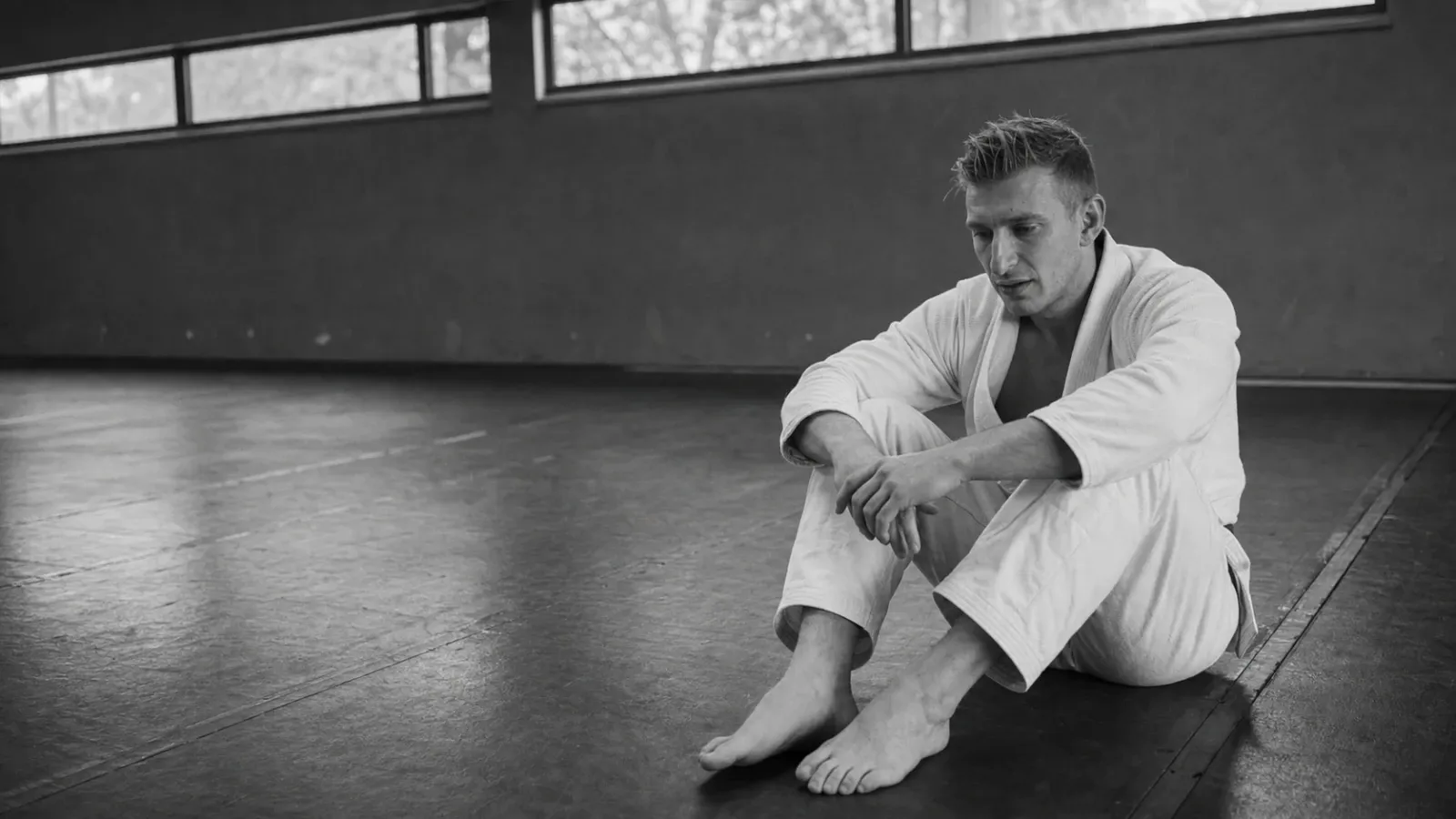
Not unfit. Not unwilling. Just lost. I turned up two or three times a week, drilled whatever was on the board, and then in sparring I lay under someone and had no idea what was happening to me. I knew the names of positions. I could not recognise them from underneath.
A few years later I found out I was not unusual. Over 80% of people who start BJJ quit within two years. Most of them never get a blue belt. Every coach I have put that number to has nodded.
The question is why, because the usual answers do not hold up.
The explanations that do not explain it
Ask people why beginners quit and you get the same list. Injuries. Money. Time. Ego. Life got in the way.
All of those are real. None of them is the pattern.
Injuries happen at every belt, and purple belts do not quit at anything like the rate white belts do. Money and time are the same for the beginner as for the person who has trained for ten years, and the ten year person keeps paying. Ego gets blamed a lot, but I have watched plenty of humble, patient adults drift away without any drama at all. They just stopped coming.
Here is what I think is underneath all of it. When you start, you cannot see what is happening. And when you cannot see what is happening, you cannot see yourself getting better. Progress in BJJ is slow anyway. Progress you cannot perceive is indistinguishable from no progress. At that point quitting is not weakness. It is a rational response to the evidence you have.
What confusion feels like from the inside
The coach demonstrates a technique from where they are standing. You see it from the side, once or twice, at full speed and then slowly. You drill it with a compliant partner and it more or less works.
Then you spar. Someone puts you in side control. You are now looking at the ceiling, or at an armpit. The angle you learned the escape from no longer exists. You cannot see where their weight is, where their arm is, or what your own hips are doing. So you do the thing every beginner does, which is push with your arms, burn out, and get submitted.
You go home knowing the technique did not work, but with no idea why. Next class is a different technique. The one from last week has already gone.
This is the loop. Watch, drill, spar, fail, forget. Repeat until you either break through or stop coming.
Why more video does not help
The natural fix is more instruction, so people buy instructionals and watch YouTube. There is more BJJ video available now than anyone could watch in a lifetime.
It does not fix the problem, because the problem was never a shortage of content. It is a shortage of clarity. Video gives you one camera angle, chosen by whoever set up the tripod, and it is almost never the angle you will actually experience. It moves at its own pace. It cannot tell you whether you understood it. And it assumes knowledge you do not have yet: a black belt explaining a sweep will skip over what “get your hip out” means, because to them it is obvious.
So the beginner ends up with more information and the same confusion.
What actually gets people through
The people who make it past the two year mark are not the strongest or the most athletic. Talk to them and a pattern shows up. At some point, something clicked. Frames. Or hips. Or the idea that every position is really about where the weight is. One concept made sense, and from then on sparring stopped being chaos and started being a series of recognisable problems.
That moment of understanding is the thing. Everything we do at Beyond the Mat is an attempt to make it arrive sooner, and for more people.
We think it needs four things that video cannot give you.
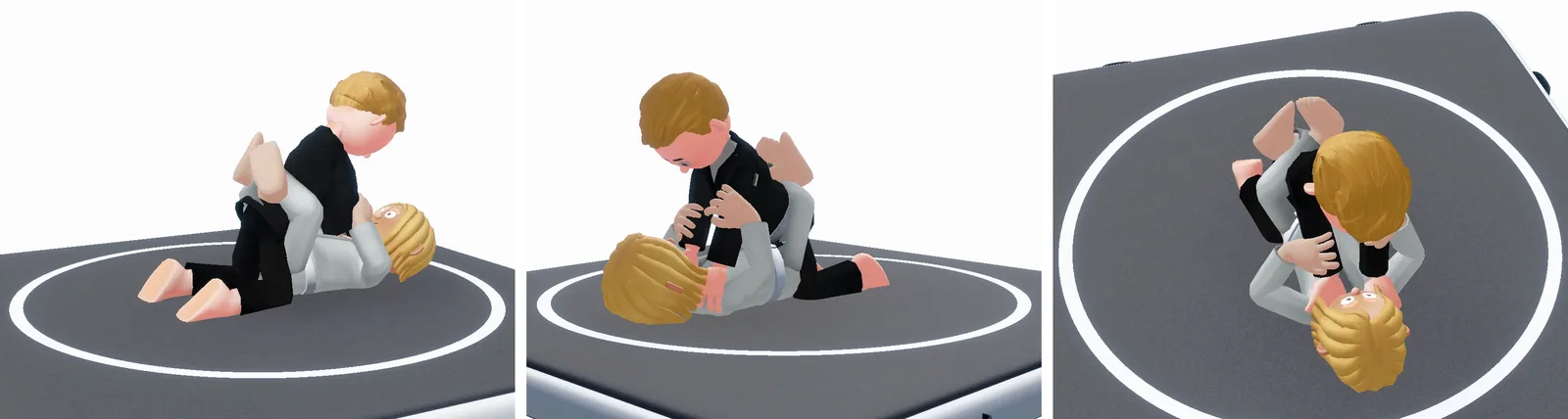
You need to see the position from where you will actually be. Underneath. Behind. From under the mat, if that helps you understand where their weight is.
You need to check that you understood it, rather than only that you watched it. A question you might get wrong is worth more than a demonstration you nodded through.
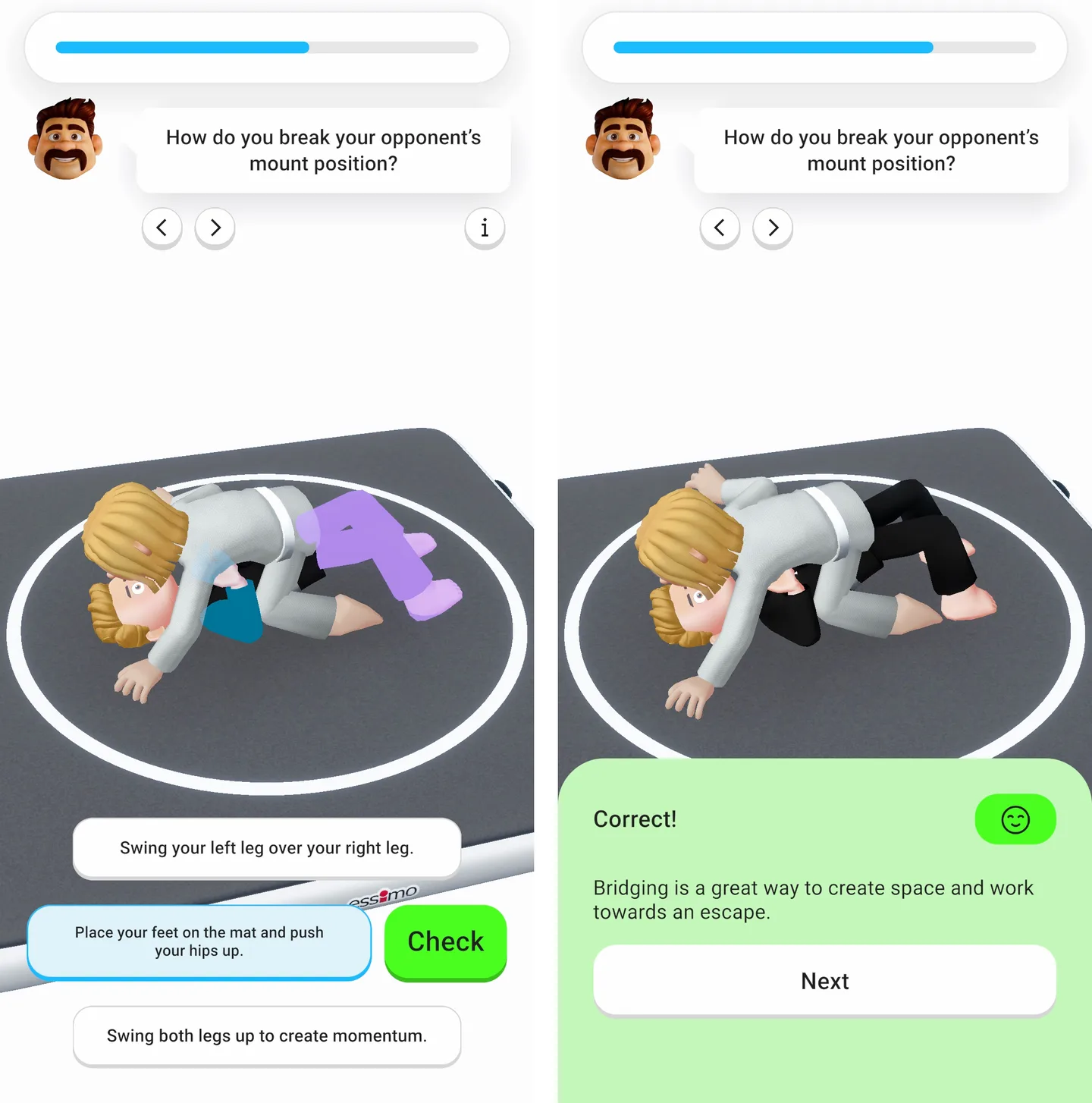
You need it in small pieces, often, so the concept is still in your head when you step on the mat on Tuesday.
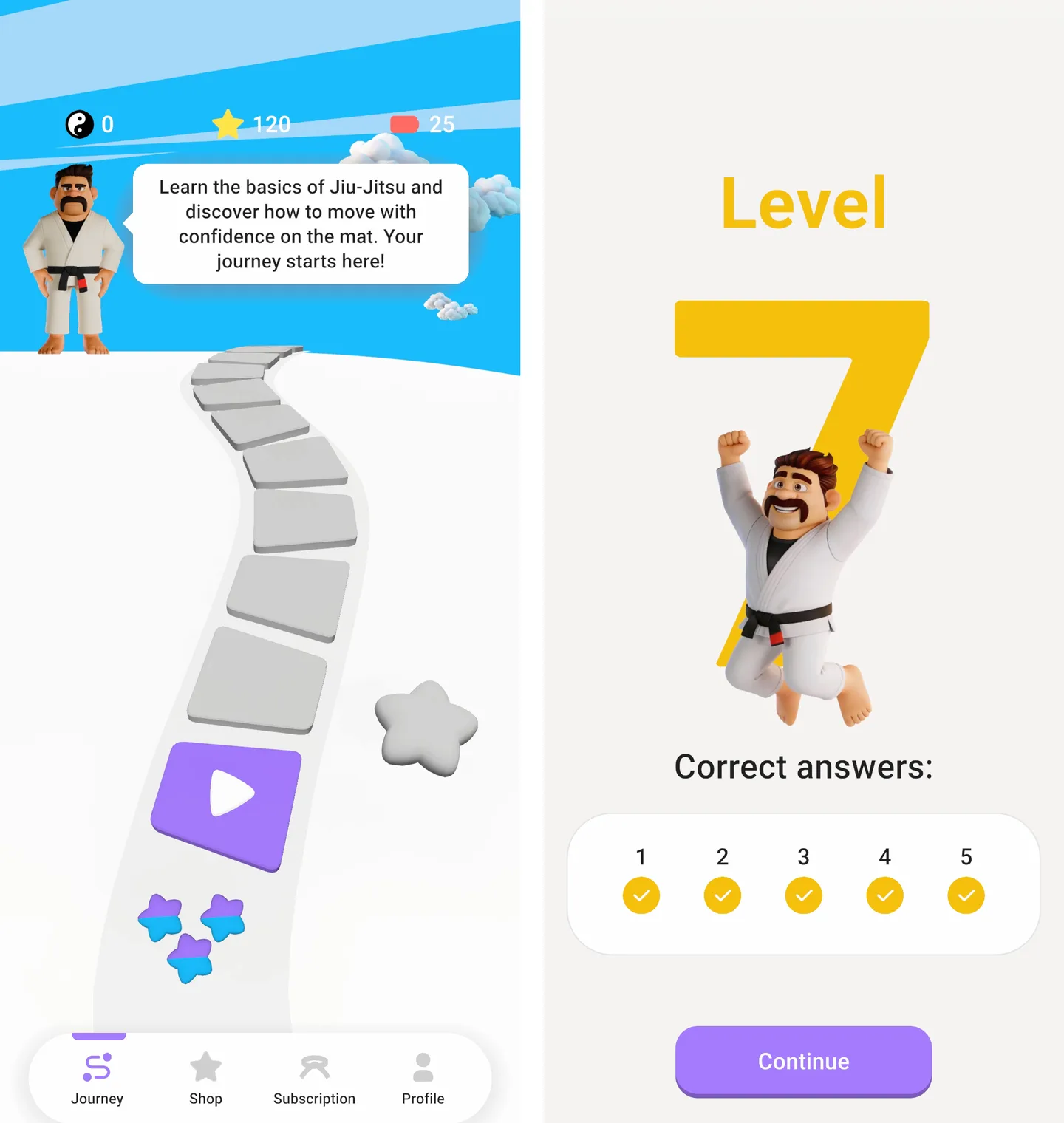
And you need to see progress. Not a belt every two years. Something this week.
What this is not
I want to be clear about one thing, because coaches ask about it.
None of this replaces a coach or a club. Understanding a position on a screen is not the same as surviving it under a heavier training partner, and it never will be. What it does is make the time on the mat count for more. You arrive already knowing what side control is supposed to feel like, so the coach can spend less time re-explaining frames and more time actually coaching you.
That is the whole idea. Fewer people lost in the first two years. More people around to become the blue belts who help the next lot.
If you are in that first year and it all feels like chaos, it is not you. It is the way the sport is usually taught. Stick with it, find the one concept that clicks, and the rest starts to arrange itself around it.
We built an app to help with exactly that. It is on the App Store and on Google Play, and the lessons are free. You can find it at beyondthemat.app.