
Thought leadership 6 min read
Duolingo built a habit machine. A BJJ app has to do something harder.
A teammate sent me a video last week about Duolingo. The argument in it is one I have heard in some form for years, and it goes like this: the app got extremely good at making people open it every day, and rather less good at making them able to speak.
It is worth taking seriously, because we are building a gamified learning app too.
The complaint, stated fairly
The case against Duolingo is not that gamification is silly. It is that the reward and the skill came apart.
A streak rewards showing up. So people show up, and the sensible way to protect a long streak is to do the easiest lesson available rather than the one that might defeat you. Multiple choice questions reward recognition, so people get very good at recognising Spanish and stay bad at producing it. Neither of those is the user being lazy. It is people doing exactly what the scoring told them to do.
The company has not exactly hidden this. When growth slowed in 2026, the fix announced was more engagement rather than better teaching: the CEO shifted the company’s stated priority from making money to daily active users, and one of the levers that moved the number in the second quarter was reviving lapsed streaks. Investors repriced the business hard through the year, with the shares down around 41% over 2026 and roughly 80% off their peak. Whatever else that is, it is a company whose main instrument is the streak, being asked to pull the streak lever harder.
I am not interested in dunking on them. They built something hundreds of millions of people use, and a lot of those people learned something real. The interesting question for us is narrower. Why did it go that way, and does the same thing happen to us?
Why the trap exists
Here is the part I think most of the criticism misses.
For a language app, the app is the entire learning environment. There is no Tuesday night where a native speaker corrects your word order and you feel it land. So the app has to be the teacher, the classroom, the practice partner and the scoreboard all at once. And the moment a single product is also the scoreboard, the scoreboard is the thing that gets optimised, because it is the only number anybody can see.
Nothing in the user’s week contradicts it. You can hold a two year streak and never once have a Spanish speaker look confused at you. The feedback that would puncture the illusion is simply absent.
That is the trap. It is structural, not moral. Put me in charge of Duolingo and I would feel the same gravity.
The mat is the part we did not have to build
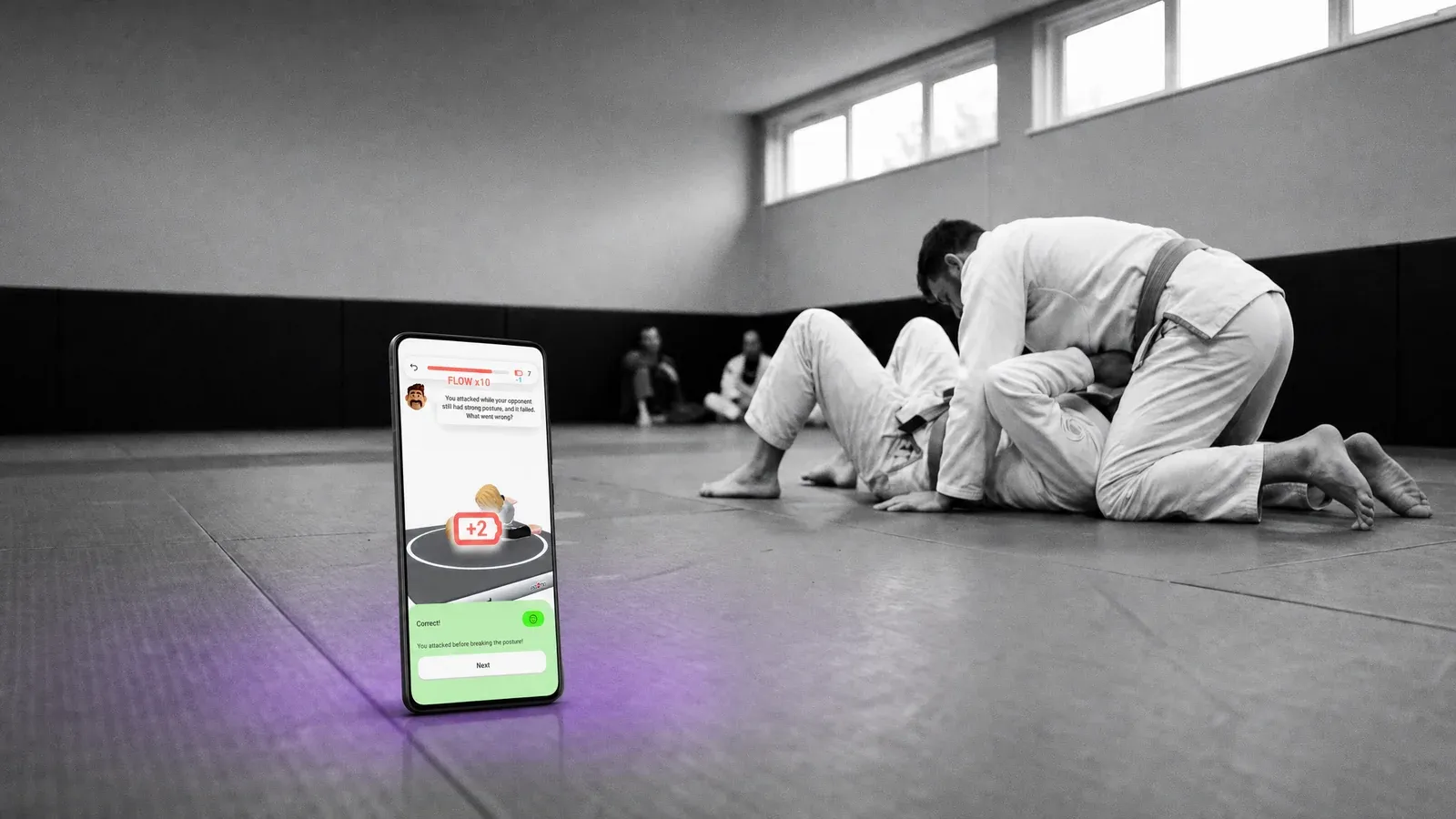
Our users are not learning jiu-jitsu from us. They are learning it in a gym, two or three times a week, from a coach, with a person actively trying to stop them.
If the language equivalent existed, it would look absurd on paper: do five minutes on your phone in the morning, then go to Italy twice a week and be made to speak Italian to Italians who will not switch to English for you. Nobody would finish that programme with a beautiful streak and no ability to speak. Reality would have audited them on Tuesday.
That audit is the whole difference. You cannot point chase your way through somebody passing your guard. There is no easy lesson you can repeat to protect your record when a purple belt is on top of you. Our users get tested every week by a system we do not control and cannot soften, which means we are structurally unable to sell them an illusion of competence for very long. They will find out.
So the design question changes shape. We are not trying to be the classroom. We are trying to be the bit between Tuesday and Thursday, which is where beginners currently lose almost everything they were shown. Most people quit inside two years, and confusion is usually the reason, not fitness and not toughness.
What we will not do
Structure helps, it does not make you immune. These are the specific things we have decided against, so you can hold us to them.
No guilt notifications. If you have not opened the app, that is information for us, not a reason to imitate an ex partner.
No streak sold back to you. The moment a broken streak becomes something you can buy back, the streak has stopped being a record of learning and become a product line. That is the exact point where a company’s interest and a learner’s interest split.
No points for the lesson you already know. Repeating something easy to keep a number alive is the failure mode of the whole category. If you can already answer it, we would rather move you on than pay you to stand still.
No claim that the app is enough. It is not. We say so in the app, on the site and in what Beyond the Mat is and is not. An app that tells you it can replace mat time is lying about something checkable.
What we are building instead
Two things, both aimed at the same idea: tie the app to the class rather than to itself.
The first is already in there. Every lesson asks you something you can get wrong, because trying to remember is what builds memory and watching is not. That is not a hunch, it is one of the better established findings in learning research, and we have written up the evidence separately rather than repeating it here. The short version is that a question you fumble and then understand beats a video you nodded along to.
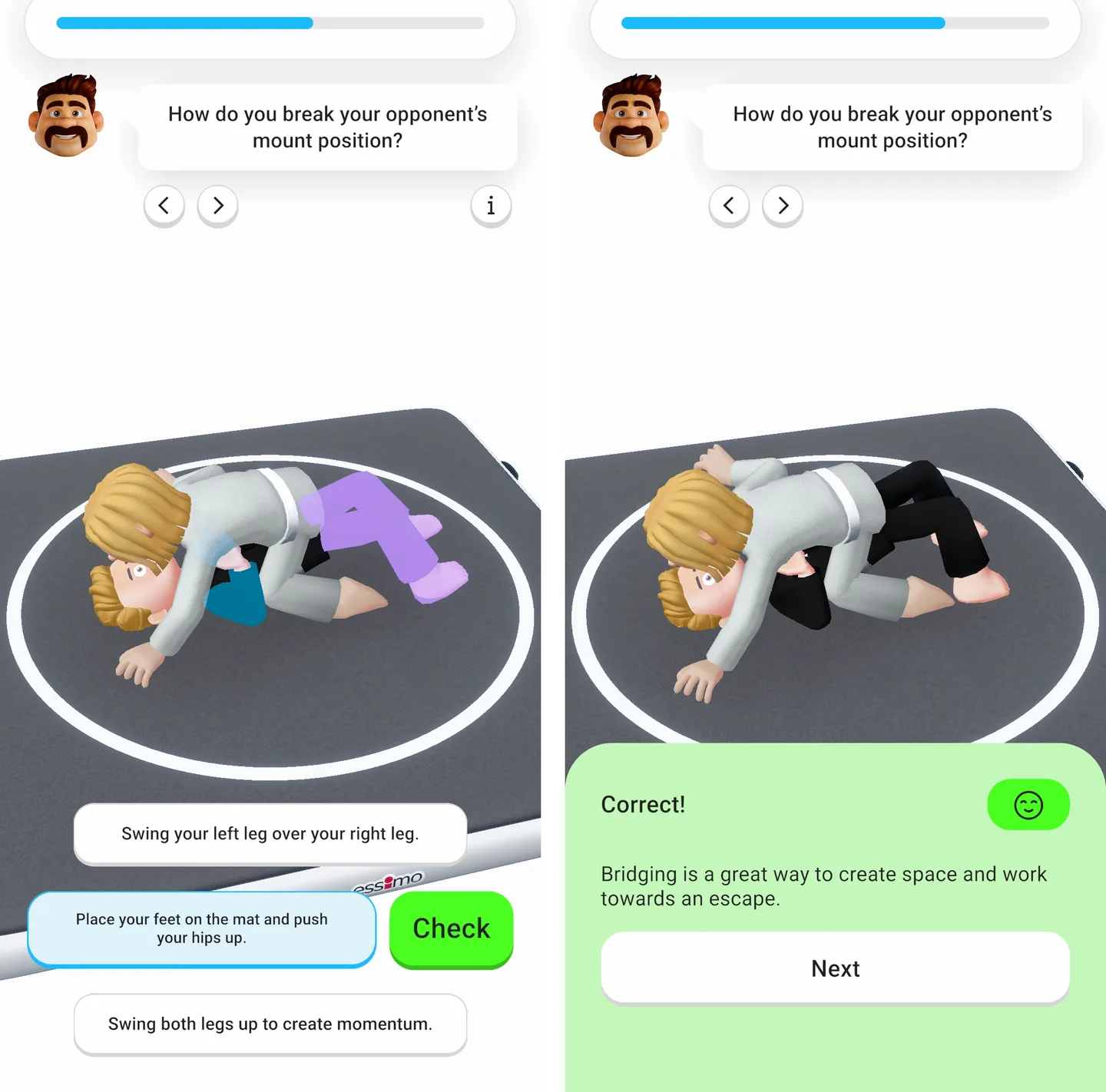
The second is the one I am more excited about, and it is not finished. We are building towards coaches being able to see what their members actually know: which positions have landed, which ones keep getting answered wrong, where the class as a whole is thin. Then a coach can push the lessons that match what was taught on the mat that night, so Wednesday’s five minutes revisits Tuesday’s class instead of some unrelated position the algorithm chose.
That closes a loop a language app cannot close, because it has nobody standing in the room. Coaches already know their students forget between classes. Nobody has given them anything to do about it. When the club tools open, they will be free, for reasons we will explain properly at the time.
Where this could still go wrong
I would rather write this bit than have somebody else write it about us in two years.
We do use levels, stars and a daily lesson, so this is a set of commitments rather than clean hands. If our numbers ever go flat, the cheapest available fix will be an engagement fix, and it will be dressed up as a learning feature. That is how it happens to everybody. It is not a temptation you defeat once.
So the honest test is not what I have written here. It is whether, in three years, you can pay us to repair a broken streak. If you can, we lost the argument.
Emma looks after learning paths, review and habits in the app, and every one of those decisions runs through the question of whether a thing helps you remember or merely helps you return. Five minutes, one position, every angle. Free on the App Store and Google Play, at beyondthemat.app.